
 USD
 Spain & Europe · EUR
 Mexico · MXN
NR and Q10: Why do you need two supplements for cellular energy?
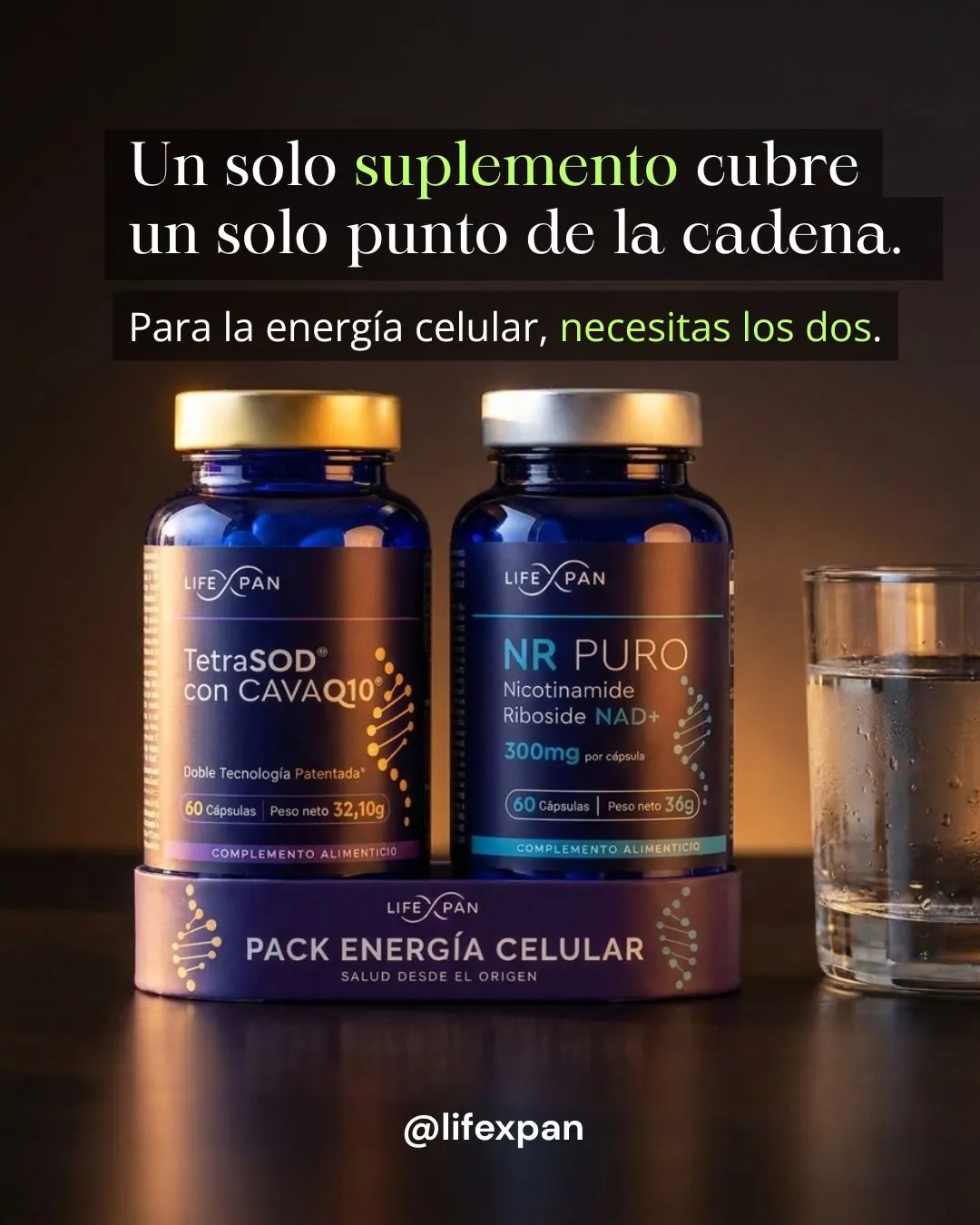
If you've taken an interest in cellular energy, you've probably heard about NAD⁺ and coenzyme Q10 separately. Each has its own benefits, its own studies and its own community of advocates. But there's something that's almost never explained properly: both work within the same chain, at different points, and what one does isn't much use without what the other does. It's like having fuel but no spark, or the other way round.
In this article, we explain why the logic of combining them isn't marketing — it's biochemistry. And why taking them together makes a kind of sense that choosing just one doesn't.
⚡ Cellular energy & Protocol · 6 min read · Educational information
The chain that produces your energy: a quick recap
All the energy your body uses — to move, think, breathe, repair tissue — is made in the mitochondria, through a process called the electron transport chain. It's a sequence of reactions in which electrons pass from one molecule to another, releasing energy at each step, until they produce ATP — the energy currency of every cell.
The important thing to understand about the synergy is that this chain isn't a single step: it's a sequence with several key points, each with its own leading molecule. And that's where NAD⁺ and coenzyme Q10 come in — each at a different point.
NAD⁺: the one that hands over electrons at the start
NAD⁺ (nicotinamide adenine dinucleotide) is the coenzyme that picks up the electrons generated when your body breaks down food — glucose, fats — and delivers them to complex I, the entry point of the electron transport chain. Without enough NAD⁺, those electrons never reach the chain, and the whole of ATP production stalls from the very first step.
The trouble is that NAD⁺ levels decline with age — in some tissues, by up to 50% between the ages of 30 and 50. Less NAD⁺ means fewer electrons delivered at the start of the chain, and therefore less raw material for producing energy. NR (nicotinamide riboside) is a direct precursor: your body converts it into NAD⁺ efficiently, helping to replenish what age depletes.
💡 In simple terms
NAD⁺ is like the fuel that feeds the energy production line. Without it, the factory has nothing to run on — no matter how well the rest of the machinery is working.
Coenzyme Q10: the one that carries those electrons down the chain
Once NADH (the charged form of NAD⁺) delivers its electrons to complex I, those electrons need to keep moving along the chain to complete the process and generate ATP. This is where coenzyme Q10 comes in: it's the molecule that picks up those electrons and carries them from complex I (and also from complex II) through to complex III. Without it, the electrons get stuck and the chain breaks down halfway through.
Just like NAD⁺, coenzyme Q10 production also declines with age. And since it sits at a different point in the same chain, its shortage isn't solved by more NAD⁺ — because the problem isn't at the start, it's in transit.
🔬 Key fact
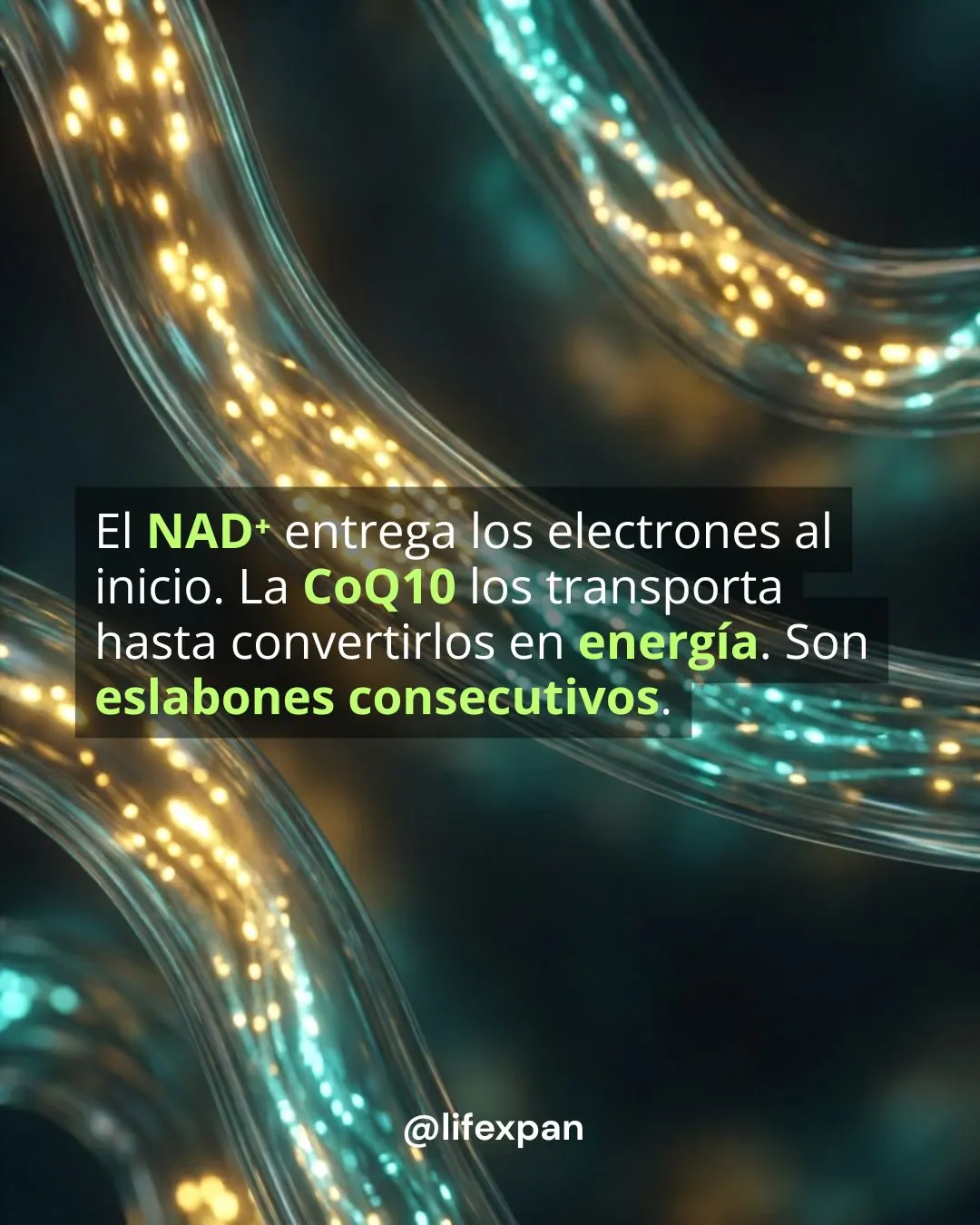
NAD⁺ and CoQ10 work literally as a pair within the electron transport chain. NADH donates electrons to complex I, and CoQ10 picks them up and carries them to complex III. They're two consecutive links in the same process — which is why it makes biological sense to approach them as a pair, not as standalone supplements.
Why one without the other performs less well
Here's the crux of the whole article, and it's simpler than it sounds.
If you have plenty of NAD⁺ (fuel) but low CoQ10, electrons reach the start of the chain but get stuck in transit — they don't convert efficiently into ATP, and oxidative stress builds up too, because those "stranded" electrons react haphazardly with oxygen.
If you have plenty of CoQ10 (transport) but low NAD⁺, the transport route is clear but not enough electrons arrive to move along it — the machinery is ready but has nothing to run on.
In both cases, the result is the same: ATP production below what it could be. And in both cases, a single supplement only solves half the problem.
✨ The key idea
It's not about taking more. It's about covering the whole chain. NR replenishes the fuel that declines with age. CoQ10 keeps up the transport that turns that fuel into energy. Together, each one helps the other perform better — because they act on consecutive links of the same process.
The evidence behind it
Research has begun to confirm what biochemistry suggests. A study published in 2024 tested NR and CoQ10 separately and found that each improves different aspects of cellular function: NR improved mitochondrial function as measured by a bioenergetic index, while CoQ10 reduced markers of inflammation. The researchers themselves noted that the logical next step is to study whether combining them produces an additional effect.
An earlier study, from 2015, had already observed that combining CoQ10 with NADH (the reduced form of NAD⁺) was associated with an increase in ATP levels, along with improvements in blood CoQ10 and in the activity of a key enzyme in the energy cycle. This is one of the first pieces of direct evidence that combining both nutrients produces measurable changes in cellular energy production.
A 2026 review sums up the principle well: NAD⁺ and CoQ10 act as a redox pair within complex I of the electron transport chain. When both are at adequate levels, the efficiency of ATP production improves — and as a side effect, the generation of free radicals is reduced, which is a by-product of a chain that isn't working well.
The routine, in practice
With all this clear, the routine becomes much simpler. Both are taken in the morning, on an empty stomach, with a glass of water.
NR Puro replenishes the NAD⁺ that declines with age — the fuel that powers the start of the chain. One capsule in the morning.
CavaQ10® + TetraSOD® is the first water-soluble CoQ10, which means it can be taken on an empty stomach without needing fat — something conventional CoQ10 can't do. It also includes TetraSOD®, the antioxidant enzyme that protects the chain from the oxidative stress generated by its own activity.
One gesture, two capsules, a glass of water. And the energy chain covered from start to finish.
⚠️ An important note
If you take regular medication — especially blood thinners or blood pressure treatment —, are pregnant or breastfeeding, consult your healthcare professional before supplementing. Food supplements are not a substitute for a varied and balanced diet and a healthy lifestyle.
Conclusion
The question "is NR or CoQ10 better?" starts from a false premise: they're not alternatives, they're consecutive pieces of the same chain. Choosing between one or the other is like choosing between having fuel or having an engine — you need both for something to move. The science backs it up, the biochemistry explains it, and the routine makes it easy.
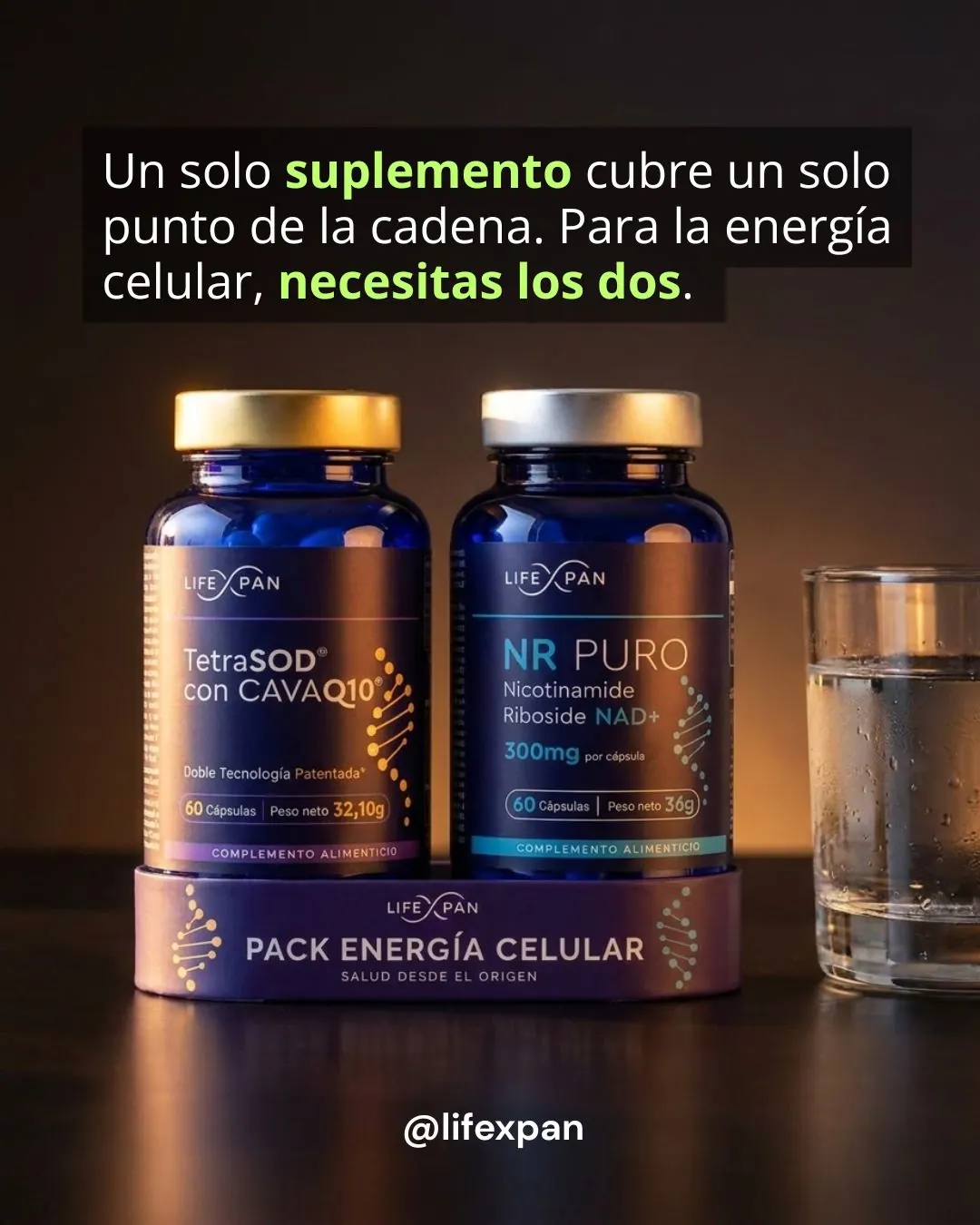
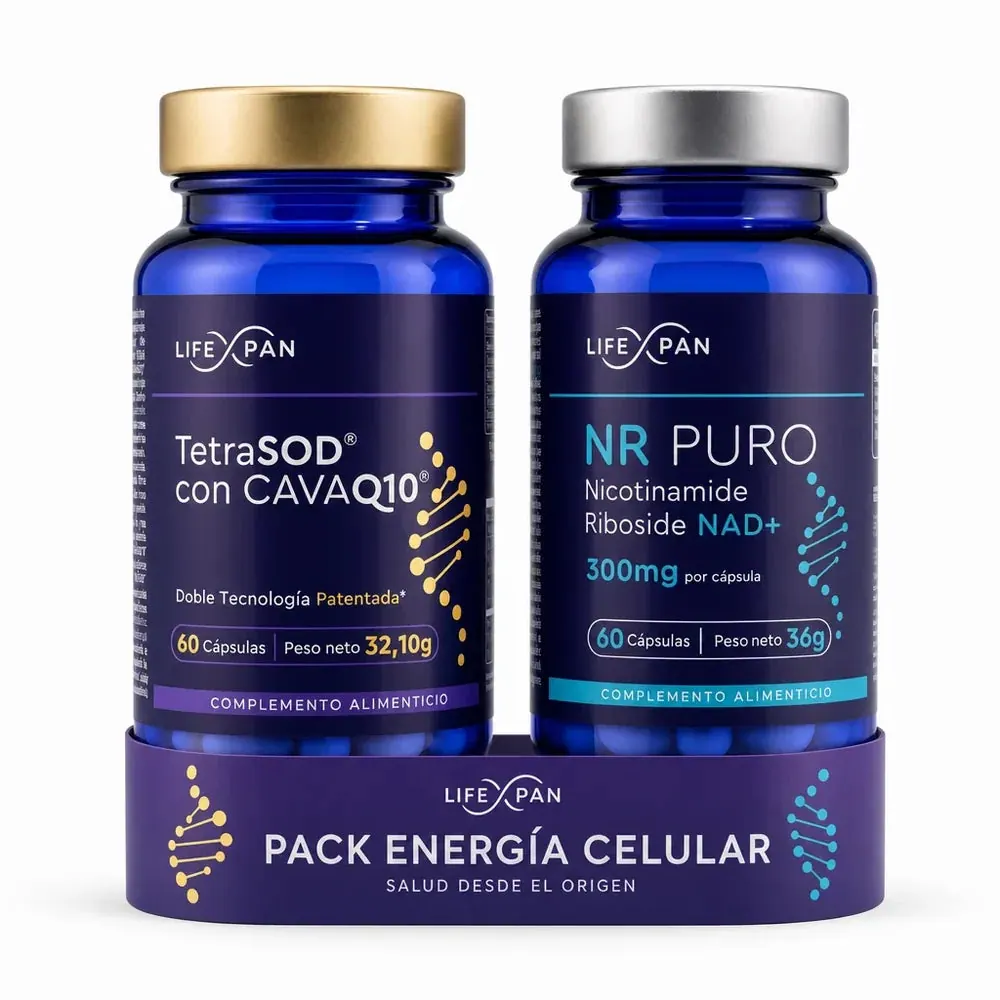
⚡ NR Puro + CavaQ10® + TetraSOD® Pack by LifeXpan®
The fuel and the spark of your cellular energy, together every morning. NR to replenish NAD⁺, water-soluble CoQ10 for electron transport, and TetraSOD® for antioxidant defence.
Scientific references
Castro-Marrero, J. et al. (2015). Does Oral Coenzyme Q10 Plus NADH Supplementation Improve Fatigue and Biochemical Parameters in Chronic Fatigue Syndrome? Antioxidants & Redox Signaling, 22(8), 679–685.
Roshanravan, B. et al. (2024). Supplementation with Nicotinamide Riboside and Coenzyme Q10 in Chronic Kidney Disease. Journal of Clinical Investigation.
Mantle, D. et al. (2024). Coenzyme Q10 and NAD+ as potential synergistic supplements for mitochondrial bioenergetics. Q10facts.com / review article.
Yusri, K. et al. (2025). The role of NAD+ metabolism and its modulation of mitochondria in aging and disease. Nature Aging.
Hernández-Camacho, J.D. et al. (2018). Coenzyme Q10 Supplementation in Aging and Disease. Frontiers in Physiology, 9, 44.
CavaQ10® and gamma-cyclodextrin technology are brands and technology of WACKER Chemie AG, used under licence. TetraSOD® is a registered trademark of Fitoplancton Marino, S.L., used under licence. Informational content. Does not constitute an authorised health claim.
ATP production mitochondrial biogenesis electron transport chain electron transport chain supplements how NAD and Q10 work together in mitochondria mitochondrial complex I mitochondrial oxidative stress NR and CoQ10 together NR CoQ10 pack NADH CoQ10 redox pair why combine NAD and coenzyme Q10 why one supplement isn't enough for energy morning cellular energy protocol which is better, NR or CoQ10 can NR and coenzyme Q10 be taken together NR and coenzyme Q10 synergy combined cellular energy supplements